

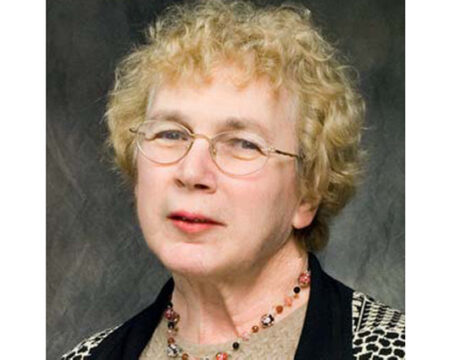
During this, the 2014 American Cytogenetics Conference,
we honor the career of Dorothy Warburton, PhD, a
founder of the field of human pre- and postnatal cytogenetics.
Her contributions span over half a century, which
include serving on the Founding Board of the American
College of Medical Genetics and the International Committee
on Cytogenetic Nomenclature. For her work in
human genetics and cytogenetics, she was awarded the
William Allan Award in 2006, one of only five women
recipients. Dorothy has been a driving force for understanding
the biological importance of aneuploidies and
spontaneous abortion in human development, health and
disease.
Dorothy was born in Canada, and was interested in
biology and natural history from childhood, as attested
to by the dead animals she brought home to dissect and
her frequent attempts to organize her friends into a ‘Nature
Club’. She entered McGill University in Montreal as
a Biology major but switched to a Genetics major after
taking her first genetics course. At that point she was
hooked. McGill was at that time one of the few places in
North America where one could major in Genetics and
also pursue a PhD in Human Genetics. Dorothy’s mentor
at McGill was Clarke Fraser, who founded one of the
first Departments of Medical Genetics at the Montreal
Children’s Hospital. He introduced her to the scientific
method, and also to the field of genetic counseling. Dorothy’s
second area of interest was mathematics and statistics,
and this played well into the human genetics of the day, which was largely based on diagnosis and risk estimates.
Throughout Dorothy’s career, the over-all theme
has been the application of rigorous statistical and epidemiological
principles to the study of human chromosome
abnormalities.
When Dorothy began working on her PhD thesis subject
on the epidemiology of spontaneous abortion, human
cytogenetics did not yet exist, nor did the knowledge
of the importance of cytogenetic abnormalities to reproductive
loss. She did, however, hypothesize that aneuploidy
would explain many of the features of spontaneous abortions. When Carr did discover the major role played
by chromosome abnormalities in 1964, it was obvious
that further analyses of spontaneous abortions required a
knowledge of cytogenetics.
Dorothy had married Toney Warburton, a fellow
graduate student, in 1957. By the time they had both received
their PhDs in 1963, the family included three children.
Toney accepted a job in New York at Barnard College
and Dorothy was lucky to be accepted into the lab of
O.J. (Jack) Miller in Ob-Gyn at Columbia Medical School.
A fourth child was born in New York. There she learned
cytogenetic techniques and also was stimulated to think
scientifically about human chromosomes. The field of
human cytogenetics was new and exciting: karyotypes
were the next-gen sequencing of the day. The field was
small and everyone knew each other, and it was also immediately
international in scope with major players in
France, Canada, Germany, and Italy.
The ability to make chromosome preparations from
blood samples soon made clinical studies possible. The
demand from clinicians soon overgrew the abilities of research
labs to comply. In 1969, Dorothy began one of the
earliest hospital-based cytogenetic labs at Columbia-
Presbyterian, with just one technician and herself, a microscope,
a darkroom, and no computers. The lab was
one of the first in the country to adopt G-banding procedures,
and new discoveries of abnormalities such as insertions,
dicentrics and paracentric inversions followed.
Dorothy collaborated with Anne Henderson and Kim Atwood
in one of the first studies to use in situ hybridization
(radioactive label) to localize human genes (the rDNA
genes). The group went on to study primate chromosomes,
examining the evolution of the sites and numbers
of the rDNA genes. This led to Dorothy’s involvement in
the Human Gene Mapping group, where she eventually
became curator for chromosome 13, and developed a series
of single-chromosome hybrids for use in mapping.
In 1975, Dorothy began a collaboration with Jennie
Kline and Zena Stein, returning to the past in a large 10-
year epidemiological study of karyotyped spontaneous
abortions. Unfortunately, this carefully controlled analysis
ended up finding no factors other than maternal age
that could be correlated with losses of particular karyotypes.
They did show, unexpectedly, that the 45,X karyotype
was associated with young maternal age. This study
essentially showed that none of the obvious environmental
factors such as smoking, alcohol, legal and illegal
drugs, or occupation affected the risk of spontaneous
abortion. This, plus the lack of any differences in statistics
among races, geographical regions or socio-economic
groups, led Dorothy to the idea that most reproductive
loss is not due to a pathological condition, but rather to a
programmed design set in our DNA.
Jennie and Dorothy continued to work on the causes
of aneuploidy, following up Dorothy’s proposal in 1989
of the ‘limited oocyte pool’ hypothesis to explain the effect
of maternal age on aneuploidy frequency. Carefully
controlled studies on women with and without a trisomic
loss explored the relationships between antral pool size
and hormone levels: the most recent evidence is in favor
of an association of FSH level with trisomy which is not
mediated by oocyte pool size. She has also shown that the
reported association of spontaneous abortion risk with
skewed X-inactivation does not occur when rigorously
controlled.
Dorothy was always concerned that good data were not
available for counseling even in relatively common situations,
such as a history of trisomy, or the presence of an
apparently balanced translocation or a marker chromosome
in prenatal diagnosis. Her multiple site studies of
these questions provide risks commonly used today in genetics
counseling. She speaks out whenever she sees data
being used inappropriately, such when the biases of ascertainment
are not considered in describing outcome, and
her own work is always carefully controlled and analyzed.
Dorothy has always embraced new technology as it has
entered cytogenetics, from banding to in situ to FISH to
microarrays. She believes that cytogenetics is defined by
the questions it asks not by the techniques it uses. She was
one of the first to publish on the clinical uses of microarrays,
and has just completed, with Mike Ronemus and
Mike Wigler, a survey of CNVs in two classes of congenital
heart disease that shows a 5× increase in de novo
CNVs over controls.
Dorothy admits that the time may be coming for her
to retire, but she has so far been persuaded not to by the
pleasure she still finds in teaching, research and the day
to day operation of a clinical lab, which continuously produces
new findings and new puzzles.
— Peter E. Warburton, PhD
Awards