

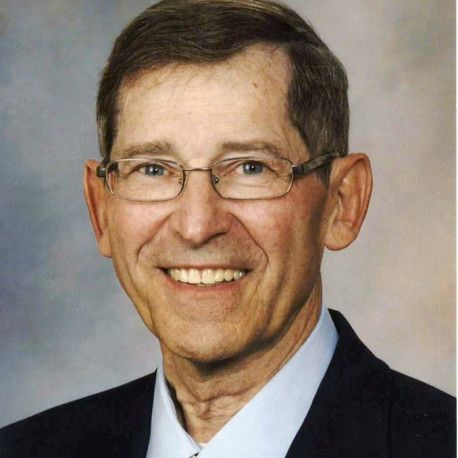
Dr. Gordon Dewald was a native of North Dakota. He earned a BS at Jamestown College in 1965, and an MS in biology in 1968 and a PhD in cytogenetics in 1972 at the University of North Dakota (UND) in Grand Forks. Like many of his contemporaries, his early training in cytogenetics employed non-banding chromosome staining methods and focused on organisms other than humans. His MS research established the karyotype of two subspecies of muskrats. His PhD research focused on meiotic studies of two species of bluestem prairie grasses. Dr. Dewald began his career in human cytogenetics at the beginning of the ‘banding era’ in the Pathology Department of UND during the completion of his graduate studies. In this capacity he developed Q- and G-banding methods and used them to study patient specimens referred to the state cytogenetic laboratory.
In 1972 Dr. Dewald moved his family to Rochester MN to begin a fellowship with Dr. Hymie Gordon in the Department of Medical Genetics at Mayo Clinic. His mission was to create a modern clinical cytogenetics laboratory for congenital disorders and to develop a computerbased videodensitometric method to digitize and analyze human chromosomes. His early publications predominately reflect his efforts to (1) develop chromosome banding techniques and implement modern cytogenetics into clinical practice, (2) define the embryological derivation of chimeras, (3) study the origin and behavior of structural abnormalities of X and Y chromosomes, and (4) automate chromosome analysis of human chromosomes. By 1973 this laboratory for congenital disorders was fully operational and Dr. Dewald was named its director.
In 1979 Mayo Clinic merged the cytogenetic laboratories for congenital disorders and hematological malignancies directed by Dr. Robert Pierre. Dr. Dewald was assigned director of this new laboratory. To accomplish the mission statement of Mayo Clinic, Dr. Dewald included education, research and clinical practice in the new laboratory. Over the years Dr. Dewald trained hundreds of cytogenetic technologists, taught countless fellows/residents in medical genetics, hematology and pathology, and annually delivered numerous lectures in the Mayo Medical School. In recognition of his efforts to train over 400 successful technologists and for his numerous contributions to cytogenetics and the Association of Genetic Technologists (AGT), he was awarded a life time achievement award by AGT in 2002. He also received an Outstanding Scientist/Physician Award in 2007 from the Mayo School of Health Sciences for his efforts in education and for his role in developing a formal cytogenetic technologist education program at Mayo Clinic.
Dr. Dewald became a leader in the cytogenetics quality assurances program of the Great Lakes Regional Genetics Group (1986–2000). He was invited in 1985 to be a founding member of a new committee of the College of American Pathologists (CAP) to create a national proficiency testing program in cytogenetics. He served on this committee for 20 years and was instrumental in the evolution of the CAP/ACMG (American College of Medical Genetics) proficiency testing program that exists today.
Beginning in 1975, Dr. Dewald became interested in chromosome abnormalities in malignant disorders. After 1979, his enthusiasm and opportunities for this subject grew significantly because cytogenetic studies of hematological malignancies became a major part of his clinical practice. His reputation for cytogenetic studies of malignant disorders led to invitations to participate in several International Workshops on Chromosomes in Leukemia and Lymphoma. Dr. Dewald promoted cytogenetic studies of malignant disorders through his role as chair of the Scientific Committee in the Chronic Myeloid Leukemia National Study Group (1995–1999), chair of cytogenetics in the Eastern Cooperative Oncology Group (1995–2006), chair of cytogenetics in the Chronic Lymphocytic Leukemia Research Consortium (2003–2006), and vice chair of the Cytogenetic Working Group to study Myelodysplasia (MDS) formed by the MDS Foundation (2005–present).
The emergence of techniques to visualize chromosome loci using fluorescence-labeled DNA probes (FISH) became important in the 1990’s. Dr. Dewald’s publication record attests to the fact that he was a pioneer in this field. He became well known through his publications and lectures for his efforts to validate new FISH assays and the implementation of this technology into routine clinical practice. He helped to formally define written methodologies to validate FISH methods for clinical practice in his capacity as vice-chair of the National Committee for Clinical Laboratory Standards subcommittee established for this purpose (1998–2000), and his continual interactions with the ACMG and CAP.
Mayo Clinic has rewarded Dr. Dewald for his 35 years of successful work in many ways. He was a two time professor in the Mayo Clinic College of Medicine; Medical Genetics and Laboratory Medicine. He was the founder and first Chair of the Division of Laboratory Genetics (includes laboratories of cytogenetics, molecular genetics, biochemical genetics and fertility testing) at Mayo Clinic: he served in this capacity for 12 years (1992–2003). In 1996, the Department of Laboratory Medicine and Pathology awarded him a distinguished career award for his contributions to the field. Dr. Dewald was elected President of the Sigma Xi Mayo Clinic Chapter (2005–2006) by his peers, served on the board of the Mayo Medical School, helped to introduce cost-effective genetic testing strategies within Mayo Clinic, and participated in many other important functions of Mayo Clinic.
Mayo Clinic’s principle maxim is ‘the needs of the patient come first’. This concept has been fundamental in the way that Dr. Dewald practiced clinical cytogenetics. In addition, the primary goal of his research projects has been to change clinical practice for the improvement of patient care. Dr. Dewald has published over 270 papers on his research, lectured in many countries and is respected for his expertise in clinical cytogenetics by cytogeneticists and physicians world wide.
It is with great sadness that we learned Dr. Dewald passed away on the evening of Friday, February 26, 2010 after a long courageous battle with acinar cell pancreatic cancer. Gordon is survived by his loving wife, Laurel, his daughter Stephanie Ann Dewald of Chicago, and his sons Anthony (Tony) and David and their families. He is also survived by his brother Stevan and sister Doris Dewald Hagel. Gordon is preceded in death by his parents, two brothers, and a sister. His family remembers him as a loving, affectionate, and devoted husband and father. As someone once said of other great losses, ‘we shall not see his like anytime soon’.