

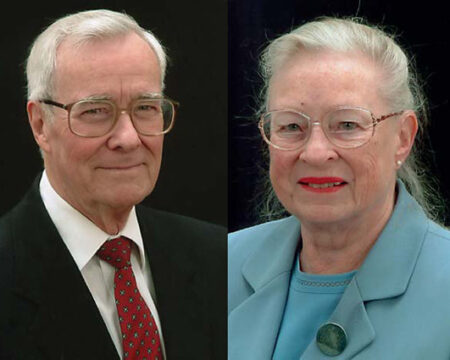
Orlando (Jack) Miller, M.D. (1950, Yale) and Dorothy Anne (Sandy) Miller, Ph.D. (1957, Yale), are the co-recipients of the ACC’s Distinguished Cytogeneticist Award for 2008. While they have made significant independent contributions, their joint research has had a larger impact on human and mammalian cytogenetics. They have trained more than 60 graduate students and fellows, served on numerous editorial and scientific review boards, and published over 250 papers, aided by grants to one or the other as Principal Investigator from the NIH, NSF, March of Dimes, and other organizations. They have influenced two generations of geneticists during their more than 40 years of research, teaching and service.
Jack, an obstetrician and gynecologist, received training in genetics (1958–1960) with Professor Lionel S. Penrose at the Galton Laboratory, University College London. They helped usher in the field of human cytogenetics by reporting, with Charles Ford, the first XXY/21-trisomic male (1959) and, independently, an XXYY male (1961). Jack moved to Columbia University in 1960 and, with Roy Breg at Yale, found still more chromosomal causes of infertility and mental retardation, e.g., an XXXXY male (1961). Jack spent a sabbatical year, 1968–1969, with Professor Henry Harris at Oxford University. Using the new technique of Sendai virus-induced somatic cell hybridization, they produced the first evidence for the existence of tumor suppressor genes.
In 1964, when their children were 4, 6, and 8 years old, Jack’s wife Sandy joined his research group and played an increasingly important role, especially in chromosome banding, mapping and comparative cytogenetics. The O.J./D.A. Miller team were the first to use interspecific somatic cell hybrids with a chromosome banding technique to assign a gene to a specific autosome (1971). They were the first to identify every mouse chromosome by a banding technique, to assign most of the mouse linkage groups to specific chromosomes, and to develop a simple way to determine the centromeric end of mouse linkage groups (1971). With Dr. B.F. Erlanger, they produced Q-, G-, R- and other banding patterns using only antibodies to the nucleosides A, T, or 5-MeC (1972–1974). They demonstrated that the absence of human ribosomal RNA and lack of silver staining of the remaining human NORs in mouse-human hybrid cells is due to the loss of one or more non-acrocentric human chromosomes, the first evidence of species-specific rRNA transcription factors. They confirmed this with Dr. Carlo Croce by showing that in rodent-human ‘reverse’ hybrids that tend to lose rodent chromosomes only human NORs are silver stained and only human 28S rRNA is transcribed (1976–1977). The Miller group discovered, in two cancer cell lines and as a normal human variant, homogeneously staining regions (HSRs) containing amplified ribosomal DNA. In all of these cases, most of the amplified rRNA gene copies had been inactivated by massive DNA methylation (1981). Dr. D.A. Miller led comparative studies on great ape chromosomes and their evolution (1977), studies on chromosome-specific human and mouse satellite DNA sequences (1990, 1991), and comparative mapping of human and a marsupial by in situ hybridization with human gene probes (1994).
Jack served on the editorial board of Cytogenetics (1961–1972), American Journal of Human Genetics (1969–1974 and 1980–1983), Human Genetics (1978–1998), and Chromosome Research (1994–1997). He was associate editor of Cytogenetics and Cell Genetics (1972–1996) and of Genomics (1987–1993). He served on scientific advisory committees for the National Foundation – March of Dimes (1967–present), the American Cancer Society (1974–1978 and 1986–1990), and the NIH (most recently, 1991–1994, on the Human Genome Study Section). Sandy served on the editorial board of Cytogenetics (1978–1984 and 1992–1996) and was an ad hoc reviewer for more than a dozen other journals.
Jack was Professor of Obstetrics and Gynecology and of Human Genetics and Development at Columbia University from 1969 to 1985. In 1982 he was certified in both Cytogenetics and Medical Genetics by the founding American Board of Medical Genetics and served as President of the ABMG in 1985 and 1986. In 1985 the Millers founded the Department of Molecular Biology and Genetics at Wayne State University School of Medicine in Detroit, Michigan, he serving as Chair and she as Professor. In 1983 Sandy had a sabbatical at the MRC Clinical and Population Cytogenetics Research Unit, Edinburgh, UK. She was Visiting Professor, Department of Genetics and Molecular Biology, University of Rome ‘La Sapienza’ in 1988 with Professor A. de Capoa and Distinguished Visiting Fellow in the Department of Genetics and Variation, LaTrobe University, Australia in 1991 with Professor Jennifer Marshall Graves. Jack and Sandy retired in 1996, but continue to periodically attend and contribute to scientific meetings.